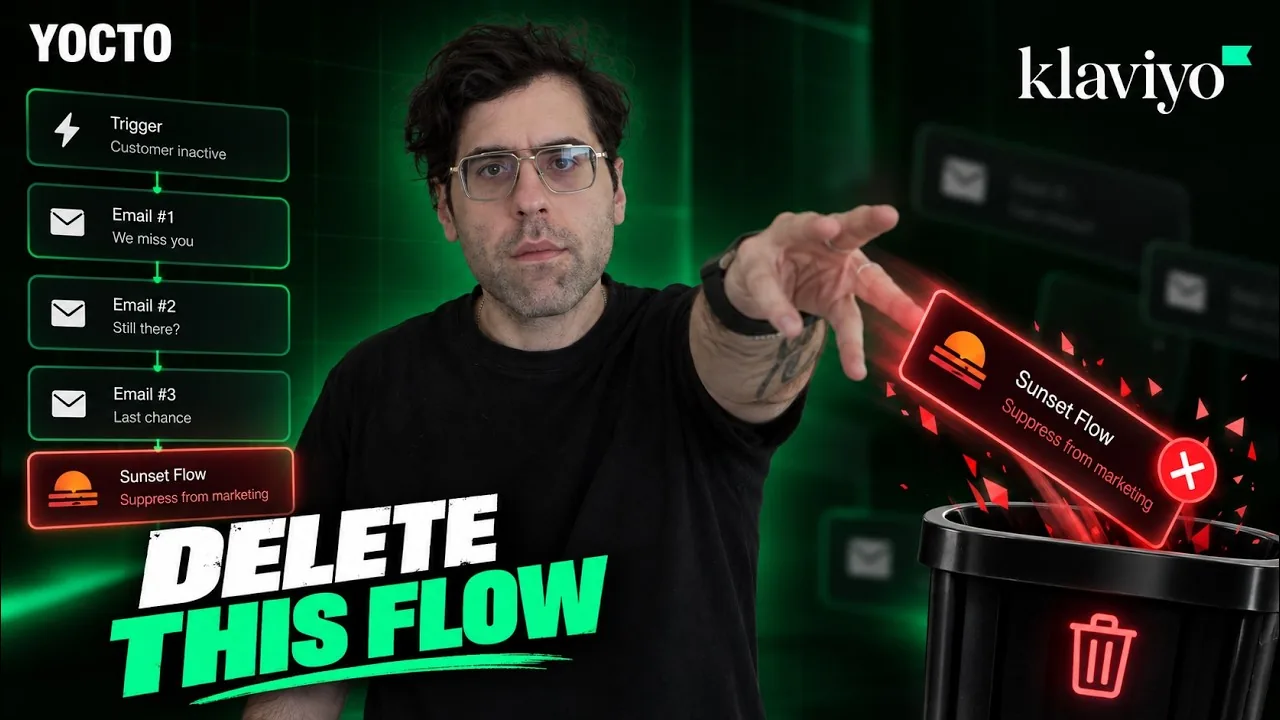
The sunset flow is one of the few pieces of lifecycle advice nobody argues with. Klaviyo recommends it, Klaviyo ships a prebuilt segment for it, every agency builds one, and it sits on the standard flow checklist somewhere between browse abandonment and the post-purchase series.
We don’t build them. We turn them off in accounts we inherit, and we have yet to see a brand regret it.
Here is the case in one paragraph. A sunset flow finds the deadest profiles on your list, the ones Klaviyo’s own segment definition selects for having never opened, never clicked, never visited and never bought, and then deliberately sends them three more emails. Those are the highest-risk addresses you own. A share of them aren’t people any more. The cost of mailing them doesn’t land on them, it lands on the inbox placement of everyone who does want to hear from you. You get one or two per cent back, briefly, and you pay for it with reputation you can’t see on a dashboard until it’s gone.
See what your Klaviyo account is leaving on the table.
Request a free Klaviyo auditWe’re a Klaviyo Elite Master, 2025-2026, and this is one of the few places where we think Klaviyo’s own documentation gets it wrong. What follows is the whole argument, including the parts that cut against us.
Key Takeaways
- A sunset flow mails your worst addresses on purpose. The segment is engineered to find zero engagement, and then you send to it three times. Every other rule in deliverability practice says do the opposite.
- Klaviyo’s own guidance concedes the mechanism. They cap the flow at three emails because, in their words, you don’t want to repeatedly contact people who are unengaged, since this can hurt your deliverability. That’s an argument for zero, not for three.
- Complaints, not opens, are what will hurt you. Google tells bulk senders to stay under 0.10% and never reach 0.30%. On a 30,000-address Gmail slice, 0.30% is ninety people who hit report spam instead of unsubscribe.
- Count ignored messages, not days. Ninety days of silence is thirteen ignored emails at weekly frequency and ninety at daily. The day count on its own tells you nothing.
- Suppress instead, and skip the send. The profile stops costing you reputation, it comes off your Klaviyo bill, and you lose nothing you actually had.
What a Sunset Flow Actually Is
A sunset flow is an automated sequence aimed at people who haven’t engaged with your email in a long time. The message is always some version of the same thing. It’s been a while. Do you still want to hear from us? Click something, or we’ll take you off the list.
If they respond, they stay. If they don’t, you suppress or delete them. The stated goal is protecting deliverability by cleaning the list, and giving subscribers one last chance before you remove them.
On the face of it that’s reasonable, and the appeal is obvious. You paid to acquire those people. Removing them silently feels wasteful, and the flow looks like the polite way to do a necessary thing.
The logic falls apart the moment you look at who’s actually in the segment.
What Klaviyo Recommends, Condition by Condition
Klaviyo’s help centre article on creating a sunset flow gives a specific segment to trigger it, and ships the same definition as a prebuilt Sunset segment in the segment library. Here it is as they write it, with what each condition is actually selecting for. Read on 25 September 2026.
| The condition, as Klaviyo writes it | What it selects for | What that means |
|---|---|---|
| Person can receive email marketing | Still mailable, so not already unsubscribed or suppressed | The flow can only reach profiles you are still billed for |
| Created is at least 180 days ago | On your list for six months or longer | Rules out anyone still inside a welcome series |
| has Received Email at least 5 in the last 72 weeks | Sent at least five emails in roughly seventeen months | Confirms they had chances, and that the address accepted mail |
| has Opened Email 0 times over all time | Has never opened a single email | Not “not recently”. Not once, in their entire history |
| has Clicked Email 0 times over all time | Has never clicked a link in an email | Removes the people who open with images off |
| has Active on Site 0 times over all time | Has never visited your site with tracking on | Cuts anyone who reads an email and comes straight to the site |
| has Viewed Product 0 times over all time | Has never opened a product page | No browse intent on record, ever |
| has Checkout Started 0 times over all time | Has never reached checkout | No purchase intent on record, ever |
| has Placed Order 0 times over all time | Has never bought anything | Never a customer, on any channel Klaviyo can see |
Read what those conditions do when you stack them. Not “hasn’t opened recently”. Has never opened, ever. Has never clicked, ever. Has never visited the site, viewed a product, started a checkout or placed an order, over their entire history with you. Plus at least five emails received, and an account at least 180 days old.
This isn’t a segment of lapsed customers who drifted. It’s a segment of addresses that have never once behaved like a person with any interest in your brand, across every signal Klaviyo can see.
And the recommendation is to send them three emails.
What Are the Odds on Email Number Seventy-Three?
Take the window Klaviyo uses, 72 weeks, and assume you send weekly, which is conservative for most ecommerce brands. That profile has received something like seventy-two emails from you and opened none of them.
Now you send number seventy-three with a different subject line. What do you honestly think happens?
Almost nothing. You’ll see one or two per cent do something, it’ll look close to random, and most of them go straight back to silence. Seventy-two consecutive non-opens isn’t bad luck or a weak subject line. A person who has ignored you seventy-two times has given you the most definitive answer available without typing a word.
Send daily and that same 72-week window is closer to five hundred ignored emails. At that point the idea that the next one changes anything stops being optimistic and becomes superstition.
This is also why the unit everyone uses is wrong. “Inactive for 90 days” describes thirteen ignored emails at one brand and ninety at another, and those are not the same person. Count the messages they’ve ignored, not the days they’ve been quiet.
The Sentence Klaviyo Wrote That Ends the Argument
From the same help article that recommends the flow, on how many emails it should contain:
It is best to limit this flow to be no more than three emails because you don’t want to repeatedly contact people who are unengaged, since this can hurt your deliverability.
Read it twice, because they’ve conceded the whole thing. Contacting unengaged people hurts deliverability. The sunset flow contacts unengaged people. All that’s left to decide is how many doses of a thing you’ve agreed is harmful you’d like to administer, and the answer they landed on is three instead of none.
If the mechanism is real at the fourth email, it’s real at the first. Nothing about the harm switches on between them.
Complaints, Not Opens
Most people defend the sunset flow on open rate, and open rate is the least of it. The thing that damages you is the complaint.
Google’s sender guidelines tell bulk senders to keep spam rates in Postmaster Tools below 0.10%, and to avoid ever reaching 0.30%. Those are small numbers and they’re measured across your domain, per day, not per campaign.
So do the sizing. Say 30,000 of your sunset segment sit on Gmail. Ninety complaints out of those 30,000 puts that day at the line Google says never to reach. Ninety people, out of thirty thousand who have never opened anything you sent and mostly don’t remember signing up, choosing report spam over unsubscribe.
And the complaints don’t sit in their own bucket. Your day’s spam rate is every complaint over everything delivered, so the sunset send pollutes the same number your real campaigns are being judged on. You can run a perfectly clean programme to 100,000 engaged subscribers and still watch your reported rate triple because of one send to people who were never going to buy.
Klaviyo’s own advice makes this worse, not better, because the whole point of the sequence is to prompt an unsubscribe. You are writing to the population least likely to remember you and asking them to take an action. Some will unsubscribe. Some will do the faster thing on their phone, which is report spam. You have no control over the split and no way to take it back.
Spam Traps Live Near Where the Sunset Flow Looks
A recycled spam trap is an email address that used to belong to a real person. They abandoned it. The mailbox provider let it hard bounce for a dormancy period, then switched it back on as a trap. The period varies by provider, but the range everyone quotes is roughly six to twelve months, with Spamhaus describing dead addresses bouncing for twelve months or more before reactivation.
What makes them relevant here is what they’re for. Recycled traps aren’t the ones that catch people who bought a list. That’s what pristine traps do, addresses that never belonged to anyone and were seeded to catch scrapers. Recycled traps exist to identify senders who keep mailing inactive users and don’t clean their lists. Someone designed a mechanism specifically to catch the behaviour a sunset flow performs, three times, on your densest concentration of candidates.
The honest caveat, because it matters: a pure recycled trap hard bounces during its dormancy, and Klaviyo suppresses hard bounces automatically. So a profile that bounced its way through the whole dormant period is usually gone from your mailable list before the trap reactivates, and Klaviyo’s segment requires that the profile can still receive email. That takes the edge off the worst version of this argument, and you should discount it accordingly.
What it doesn’t take off the table is the rest of the pool the sunset segment collects. Addresses that were typed wrong at a popup and land on a catch-all domain that accepts everything. Addresses entered to get a discount code by people using a burner. Corporate addresses belonging to people who left the company two years ago. Role accounts. None of those bounce cleanly, all of them sit in a segment defined by never having engaged, and every one is a send with no upside and a non-zero chance of a complaint or a block.
A trap hit is not priced like a bad open rate either. It goes to reputation directly, it can put you on a blocklist, and the damage falls on every send after it, including the ones to the customers who actually buy from you.
The Arguments For Sunset Flows, Answered Properly
“I paid to acquire these people.” You did, and it’s gone. Sunk cost doesn’t become recoverable because you send another email. And look at what you actually bought in this particular segment: an address that has never opened anything, never visited the site and never ordered. You didn’t acquire a customer. You acquired a string of characters that passed form validation.
“But some of them do re-engage.” True, and we’d put it around one to two per cent. The question was never whether you recover anybody. It’s who pays for it. The cost of mailing the other ninety-eight per cent shows up as worse inbox placement for the subscribers who open everything you send. You’re taxing your best customers to run a lottery on your worst addresses.
“Klaviyo recommends it, and they see more data than you do.” They do, and on most things we’d defer to them without hesitation. Here their own article concedes the mechanism in the same breath as prescribing it, which is the part we can’t get past. There’s also a structural point worth making once: platforms priced on active profiles have no commercial reason to hurry you towards suppressing them. We’d rather name that than pretend the incentive isn’t there.
“We need it for consent reasons.” A re-permission campaign is a different exercise with a different purpose, and if your legal position calls for one, run it. But that’s a one-off with a compliance job to do, not a permanent flow with a deliverability job to do, and even then the never-engaged-ever cohort is the group you exclude instead of the group you target.
“Our sunset flow gets a 15% open rate.” Then it isn’t running on the segment described here. A flow with a real open rate is reaching people who have engagement history, which makes it a lapsed-customer campaign wearing the wrong name. We’re in favour of those, and the distinction is the whole next section.
“Removing thousands of profiles will tank our list size.” It will, on the vanity number. It won’t touch the revenue, because those profiles produce none, and it’ll cut your Klaviyo bill, because suppressed profiles fall outside the active count you pay for. If a smaller list that performs better is a problem for someone in your business, that’s a reporting conversation, not a marketing one.
Three Tiers, and Only One of Them Gets a Message
Stop sorting by recency on its own. Sort by engagement history first, then by how many of your messages the profile has ignored.
| Tier | What the profile looks like | What we do | Why |
|---|---|---|---|
| Tier one: never engaged | Zero opens, clicks, site visits and orders over all time. Five or more emails received, six months or older | Suppress today, with no send | Highest risk, lowest odds, and they sit on your bill |
| Tier two: engaged once, long dead | Real history somewhere, sometimes an order, then twenty to a hundred consecutive ignored sends | Suppress, or make exactly one attempt to a small batch | The history is real but stale, and a sequence is not justified |
| Tier three: recently lapsed | Opened regularly, bought, and went quiet in the last few weeks or months | A proper lapsed-customer campaign with a real offer | The only tier with an audience that can answer |
Tier one isn’t a marketing problem at all. Zero engagement across their whole history, five or more emails received, six months or older. Suppress them today, with no send. These carry the highest risk, the lowest recovery odds and a running cost, and there’s no version of the maths where mailing them wins.
Tier two is a judgement call that should usually resolve as suppression. There’s history here, sometimes even an order, but they’ve since ignored twenty, fifty, a hundred messages in a row. If you have a specific commercial reason to make one attempt, make exactly one, to a small batch, on a warmed sending setup, with a complaint threshold you write down before you press send and honour afterwards. Otherwise suppress and move on.
Tier three is where the money is, and it was never a sunset flow. A subscriber who opened regularly, bought something and went quiet eight weeks ago is a lapsed human being with a reason. That’s a lapsed-customer campaign, and it deserves a real offer, proper segmentation and your attention. The mistake we see most often is brands running the same sad “do you still want to hear from us?” message at tier three that they run at tier one, when tier three is the only tier that was ever going to answer.
 Email revenue for the FT1000 fastest-growing company in EuropeREAD ITYOCTO CASE STUDY33.6%
 Revenue growth on 45% fewer emailsREAD ITYOCTO CASE STUDY33%
 Lower subscription churnREAD ITYOCTO CASE STUDY+110%
 Year-on-year revenue growth across the lifecycleREAD IT
 +252%
 Email and SMS-attributed revenue on a recurring programmeSOURCE78×
 Campaign ROI across BFCMSOURCE
How to Do This in Klaviyo
Build the segment, don’t build the flow. Use Klaviyo’s own conditions if you like. They identify the right people, and that was never the disagreement. Then send that segment to suppression directly instead of pointing a sequence at it.
Suppress, don’t delete. Suppression stops marketing sends while keeping the profile and its history in the account, so your historical reporting stays intact and a genuine future signup can be handled properly. Deleting throws away data you may want and buys you nothing extra on deliverability.
It comes off your bill. Klaviyo prices on active profiles, and their own documentation says suppressed profiles do not count towards your plan. On an older list carrying years of dead weight this is a real line item, which makes it the rare deliverability fix that pays you instead of costing you.
Do it in batches if the list is large. Suppressing 200,000 profiles at once is fine technically, but it will move every rate in your reporting on the same day and you’ll want to know which change caused what. Work through it over a few sessions and note the dates.
Then fix the intake, or you’ll be back here. Never-engaged profiles usually arrive in bulk from one place. An aggressive popup with a discount that attracts address-shaped noise, a giveaway, a competition entry, a list somebody imported without asking. Cleaning the back end while the front end keeps producing the same thing is a quarterly chore you have invented for yourself.
Set a standing rule and write it down. Decide the number of consecutive ignored sends at which a profile leaves your mailable audience, then enforce it on a schedule. Most accounts we audit have no rule at all, which is exactly how they end up with a list where a third of the names haven’t opened anything since the year they joined.
Where This Sits in the Rest of the Work
List hygiene is one piece of a deliverability problem and rarely the whole of it. If you’re reading this because your inbox placement is slipping, these are the neighbouring pieces.
- Email deliverability - how we diagnose and fix inbox placement, of which list hygiene is one input.
- The LTV Parthenon - our full retention methodology, and where email sits inside it.
- How to reduce churn for subscription brands - the commercial work that surrounds the email programme.
- The best retention marketing tools - the wider stack, and what each part is actually for.
So Should You Build One?
No. Build the segment, skip the send, suppress the profiles, and put the effort you were going to spend on three emails into the lapsed-customer campaign aimed at people who have shown you they exist.
If you inherited a sunset flow, turn it off before you change anything else. It’s the cheapest deliverability improvement available to most accounts, it takes about ten minutes, and nothing you value leaves with it.
And if your inbox placement is already struggling and you want to know whether the list is the cause, our free Klaviyo audit covers this directly. We’ll show you how much of your list is dead weight, what it’s costing you in both reputation and billing, and whether your problem is the list or something else entirely. Often it’s something else, and we’ll say so.
Frequently Asked Questions
What is a sunset flow in Klaviyo?
A sunset flow is an automated email sequence sent to profiles who have stopped engaging, asking whether they still want to hear from you, after which anyone who does not respond is suppressed or deleted. Klaviyo recommends triggering it from a segment of profiles created at least 180 days ago who have received at least five emails, opened zero and clicked zero over all time, and have no site activity, product views, checkouts or orders on record. The same definition ships as a prebuilt segment in the segment library.
Should you use a sunset flow?
We advise against it. The segment it runs on is, by construction, your least engaged and highest risk addresses, and sending to them is the behaviour that damages sender reputation in the first place. Suppress those profiles without the send instead. You keep the benefit of a clean list and skip the cost of three more messages to people who have never responded to anything.
Do sunset flows hurt deliverability?
Yes, and the reasoning is not controversial. Mailbox providers read engagement as a quality signal, so a send with almost no opens is a negative one, and complaints from recipients who do not remember you are worse again. Klaviyo concedes the mechanism in its own guidance by capping the flow at three emails, on the stated grounds that repeatedly contacting unengaged people can hurt your deliverability. The same logic applies to the first email as to the fourth.
What is a recycled spam trap?
An email address that once belonged to a real person, was abandoned, and has been switched back on by the mailbox provider as a trap after a dormancy period that is generally quoted at six to twelve months. Their stated purpose is to identify senders who keep mailing inactive users instead of cleaning their lists. Hitting one damages sender reputation directly and can lead to a blocklisting.
How long should someone be inactive before you suppress them?
Count messages, not days. A profile that has ignored ninety consecutive sends has told you something that a profile which has ignored thirteen has not, and both can be described as ninety days inactive depending on how often you send. Set your rule in consecutive ignored sends, write it down, and apply it on a schedule instead of when someone remembers.
What is the difference between a sunset flow and a win-back flow?
A sunset flow targets people with no engagement history, in order to remove them. A win-back targets people who used to engage and stopped, in order to bring them back. The two get confused because both go to quiet profiles, but only one of them has an audience capable of responding. Put the effort into the win-back and suppress the sunset audience without messaging it.
Does suppressing profiles in Klaviyo reduce my bill?
Yes. Klaviyo prices on active profiles and says in its own documentation that suppressed profiles do not count towards your plan, so clearing dead weight lowers what you pay as well as improving inbox placement. On an older list carrying years of never-engaged signups it is often a significant amount, and it is the rare deliverability fix with a positive cash effect.
Why do so many agencies still build sunset flows?
Because it is on every standard flow checklist, it is in the platform documentation, and it sounds responsible in a meeting. Very little of what gets repeated in lifecycle marketing has ever been re-examined against how mailbox providers actually behave. The sunset flow is the clearest example we know of advice that survives on how sensible it sounds instead of on what it does.
If you would rather have someone run this against your account, our free Klaviyo audit does that, and you keep the scorecard.